XL: The Dog In You - An Interview with Dagny Walton
Dagny Walton, aka Stray Dog Press, is an illustrator and printmaker. Originally from Colorado, she received her BA in Classical Studies from the University of British Columbia and her MFA in Fine Art from the University of Montana. She has also served as the Laura Grace Barrett artist in residence at the Zootown Arts Community Center in Missoula, MT, where she currently teaches printmaking workshops.
Dagny applies her background in Classical Studies to a literal interpretation of the myth of the American West and incorporates themes and visuals from Greco-Roman mythology in her work. Her work explores the inheritance of stolen land, the industrial exploitation of the landscape, and the deification of the cowboy archetype. She also examines the interplay between human ambition and natural entropy: the permanent consequences our actions have on the land, and the chaotic nature of the environment that threatens our own existence.
Dagny resides in Missoula, MT with her partner Alexandra and cat Sam. Her work has been shown at the Cawein Gallery in Forest Grove, OR, the Brinton Museum in Big Horn, WY, the Yellowstone Art Museum in Billings, MT, and the Missoula Art Museum, Montana Museum of Art & Culture, Allez! Missoula, ZACC Gallery, and Radius Gallery in Missoula, MT, among others. She has also been featured in I Like Your Work’s 2023 MFA Catalog, the Spring 2023 edition of Camas Magazine, and provided the cover design of Cutbank Literary Magazine, volume 95.
Join us for a conversation about weremorphology, dogmen, colonial resonances, and all things Gothic below
Instagram
A quote attributed often to Samuel Johnson goes: "He who makes a beast of himself gets rid of the pain of being a man”. Do you think that this is something the dogman, who thinks himself a wolfman, believes of himself and of animality? In other words, what are good and bad interpretations of this idea?
I think Johnson’s quote is interesting because I would be curious to know what “the pain of being a man” entails! What does he mean by “pain?” Is he referring to the idea of higher consciousness and animation (which is something I personally still attribute to animals and other creatures besides people) and how it instills guilt, misery, grief in us? If so, I think that that does apply to my dogman. I think he’s free to act as he wishes without the fear of emotional repercussions. But, there’s an exchange: in giving up the pain of higher consciousness, he’s also giving up his intentional agency. He’s enslaved to his worst impulses. I think that, while the pain of being a man may entail complex and higher emotional function, we’re also surrendering ourselves to the pain of pure appetite and the inability to moderate our own base desires. I think there’s an illusion of freedom there, just like there’s an illusion of agency to the dogman in general.
What has been your relationship with folklore in general, but specifically with cryptids and what I call weremorphs, in your medial consumption and artistic praxes?
I love folklore because it endures. Something that I get really tired of in modern media – if I can be cynical and shake my fist at some clouds for a moment – is that everything just feels like a trend right now. Things come and go, and really special things might stick around in your own mind or in a passionate group of people, but there’s so little media anymore that everyone really unifies around and engages with, like how, just as an example, if you wanted to see a new movie in the 1960’s or something, you would have to go to the movie theatre. It’s the natural effect of an over-saturation of media, I think. We could spend literally the rest of our lives consuming media alone, on our couch, and there’s a whole new oil spill of things to consume every single day.
But folklore, on the other hand, sticks around. I think there’s something about folklore that’s naturally mysterious too. Like folklore is often a basic structure – a girl wanders into a forest and encounters a beast there, for example. The structure is so basic that it can develop and grow organically. It leaves room for the teller to inject their own creativity into it, and different tellers, different audiences, different cultures, will interpret that basic structure in a huge variety of ways. It’s like your question of hybridity. Folklore naturally makes room for “what if” questions. “What if the girl was a monster herself?” “What if the beast is more than he appears?” “What if it wasn’t a forest she wandered into, but a labyrinthine castle?”
Maybe that’s why I’m so personally drawn to cryptids – they raise all sorts of questions. For me, I always wonder why cryptids show up in all these old stories. Not even old, too! I think the closest thing we have to folklore now is Creepypasta, there’s all kinds of cryptids skulking around on there that are modern equivalents to La Bête, or Dracula, or the Hide-Behind. I like to imagine why these cryptids do what they do, why they’re so specifically regional, why they pose such anecdotal danger to us.
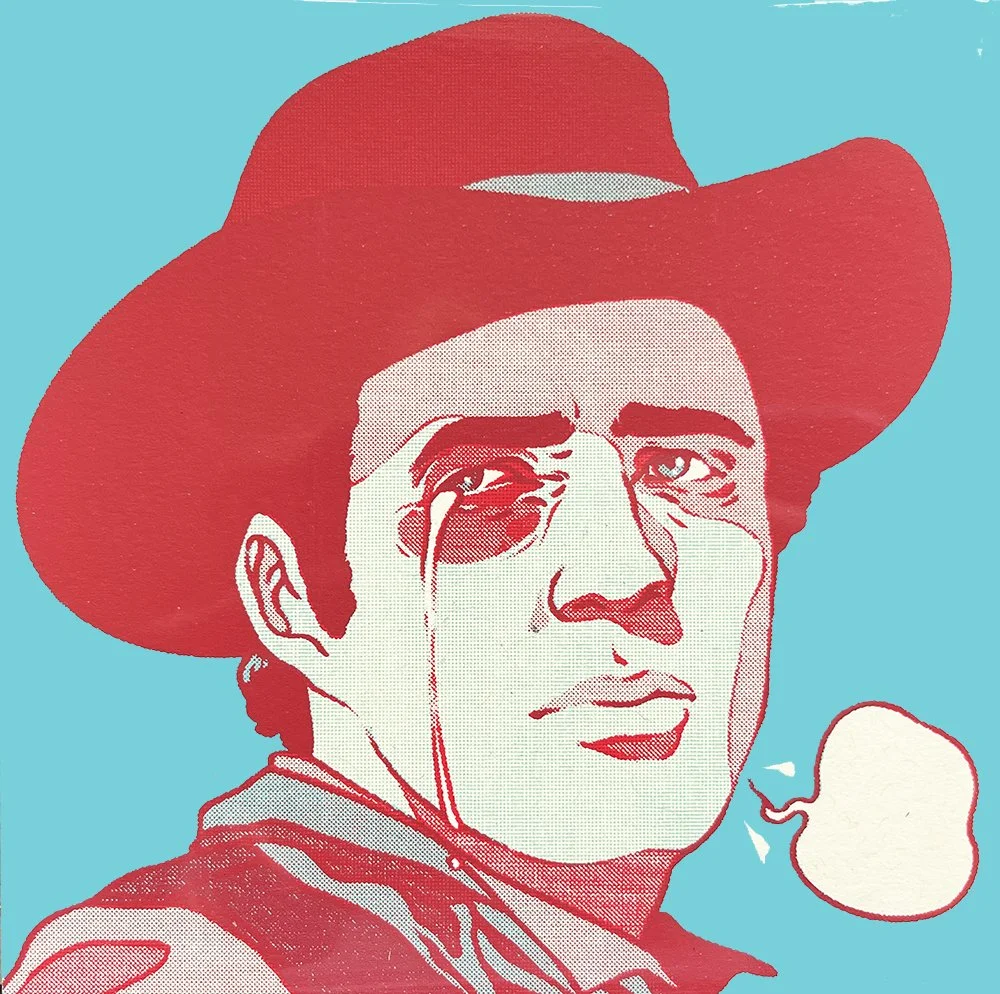
"Black Eye Crybaby" - 2026
How did the figure of the dogman come to you? What did it represent in its burgeoning? What does it mean to you now?
He just showed up out of nowhere! I was in the second year of my MFA program, drawing a triptych, and suddenly one of the figures in that triptych was a man dressed in a fringed leather jacket – very John Wayne – with red, bloody hands and the head of a Doberman. He was sort of apart from the action of that triptych, observing the scene. It felt like a definite introduction, like I was just getting to know this character, and he was just getting to know his place in the shared world of my work.
Then he kept showing up, and by the time I was making work for my thesis show, he was a very prominent character. I think he was in at least a third of the prints I made for my thesis. As I’ve gotten to know him better, I’ve realized that he’s a representation of what a settler-colonial system does to the psychology of the colonizer. Dogs are creatures that we train, that we teach to act and behave in certain ways. In this case, he’s been taught to act rapaciously, to take what he wants and run rampant over the Western landscape. He appears to be a man, so he appears to have agency, but he’s also a dog, so I think that that agency is ultimately an illusion. He acts according to how he’s been trained. I think there’s something especially scary about that decentralized kind of violence – he’s not receiving direct commands, he’s just being vicious and violent because that’s all he knows.
Hybridity is a mainstay mechanism and conceptual frame for modern horror. What do you think the notion and practice of hybridity still has to offer in thinking, making, and being today?
I’m all about hybridity! In On Writing, Stephen King talks about the power of just combining two basic ideas and seeing what happens:
“Let's get one thing clear right now, shall we? There is no Idea Dump, no Story Central, no Island of the Buried Bestsellers; good story ideas seem to come quite literally from nowhere, sailing at you right out of the empty sky: two previously unrelated ideas come together and make something new under the sun. Your job isn't to find these ideas but to recognize them when they show up.”
I think that’s an excellent way to approach creativity. It’s like any impressionist still life. A painting of a vase on its own might be aesthetically-pleasing, but if you surround that vase with other objects – an apple, a butter knife, a bouquet, a dynamic table cloth – it’s suddenly so much more interesting. It’s an exciting way to see something normal or easily recognizable from a totally different perspective. I take the same approach in my art, but what I’m doing is taking this form of modern mythology (our cultural concept of the American West), and mashing it together with much more ancient mythology (Greco-Roman pantheon, lost pagan iconography, dead mystery cults, etc). Also, as a more narrative artist, it’s fun to just imagine how a story would develop out of these hybrid ideas too. What if a cowboy came across a centaur at a river crossing, or met the god Pan out in the wilderness, or had to make a journey into some chthonic domain lorded over by a long-lost god? Those kinds of “what if, what if, what if” questions really excite me both on an artistic and a narrative level.
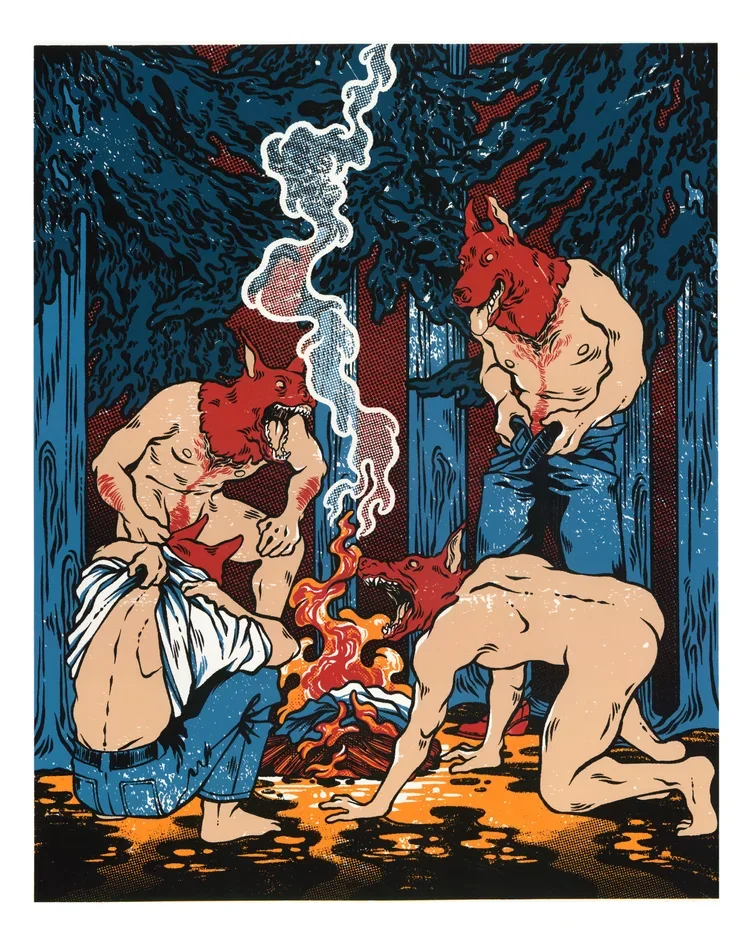
"Into What Strange Creature Are You Turning? 1" - 2022
We spoke briefly about Eggers’ Werwulf trailer and you said something interesting: “there’s nothing for my eye to go to” and getting back to more Baroque Gothic film. What three things would be in a high-budget werewolf film written, directed, and production designed by you?
Color! I’m going to shake my fist at clouds again – I’m so tired of a dark palette in horror movies. I think the Werwulf trailer was almost funny to me, because literally all I saw were dark shapes and silhouettes, occasionally a chiaroscuro shot around a blazing fire. Personally, I don’t love that. Like I said, there’s nothing for my eye to go to. How can I get curious about the story that this trailer is trying to sell to me when I have absolutely no idea what’s going on? My wife is a huge fan of Italian Giallo films from the 1970s - 90s or so, and the colors on display in those films are just phenomenal. Scarlet, soft pinks, electric purple, that strange chloriney blue. I love that kind of color in horror movies. I think it makes the horror all the more pronounced, it’s the carrot you lure the audience in with before you pull out the stick.
Humor. Similar reasoning here – as an audience member, I love the emotional switcheroo of laughing at something one moment, and then cringing away in fear the next. One of my favorite movies of all time is Antonia Bird’s Ravenous from 1999. Tonally, it’s a very strange movie. There’s an amazing, incredibly dire sequence where characters are running for their lives from the movie’s monster, and it’s set to this jangly hillbilly banjo music. It’s so funny and so scary all at once.
Subtext. Literally any kind of subtext, I don’t know, it would have to depend on what the story was. I feel like I’m really ragging on a lot of modern media here, which I’m sorry about, but I feel like a lot of modern films especially spoon-feed the audience. I think it’s always better to assume that the audience is intelligent and, even more than that, that their brains will continue to consider and chip away at your film once the credits have scrolled away if you don’t give them all the answers. Again, there’s nothing more engaging to me than a question. Why did this character act like that, what did they really want to say when they actually kept quiet? What was really going on in that scene, in the character’s internality? I think it’s a fine line to walk, certainly – to know how much information to give and how much to withhold – but a canvas with blank spaces to fill in is so much more interesting to me than a flat painting with everything present and accounted for.
What fascinates you about traditions like Catholic mythology, figures like St. Cristopher, Daniel, Nebberchudnezzer, and what you phrased so well as “animalism in fine robes”?
For me, in many ways, the lycathrope represents maximalism and bursting out. Is this the same for you? If so, how so? If not, why not?
I might answer the above two questions in one fell swoop, because they kind of touch on similar things for me. I’m really drawn to the idea of costume and “dressing up” and decoration. What do we wear to identify ourselves to our community, to indicate who we are? It’s all relative, as is everything when it comes to community. For example, there’s such a distinct look to Catholicism that’s obviously missing, culturally and aesthetically, from another strain of Christianity like Protestantism. I’m weak to Catholic maximalism in general, but I think the basic idea of decoration – especially to the point of maximalism – is really interesting when you hold it up against something like a lycanthrope.
Here you have a man who, consciously or unconsciously, is giving up his man-ness to become an animal. There’s something maximalist about just that! Like he’s maximalizing the inherent animal inside of him. But then you have depictions like La Belle et La Bete, which you told me about, where you have a man who has become an animal but who is still playing at being a man, reaching for it desperately with his gilded home and his sumptuous clothes. The layers there are fascinating. It’s why I’m so drawn to the version of the St. Christopher myth where he is cynocephalic, literally “dog-headed,” and he’s depicted as dog-headed and draped in all the trappings of Catholic dress. That version of Christopher is referred to as a barbarian by nature, almost an animal in how inhuman he is, and then he pledges himself to Jesus and becomes this decorated, regal-looking dog-man in spite of his innate animalness. That’s just exciting to me, I guess! The layers of man vs. animal, brutish vs. refined, barbaric vs. civilized …
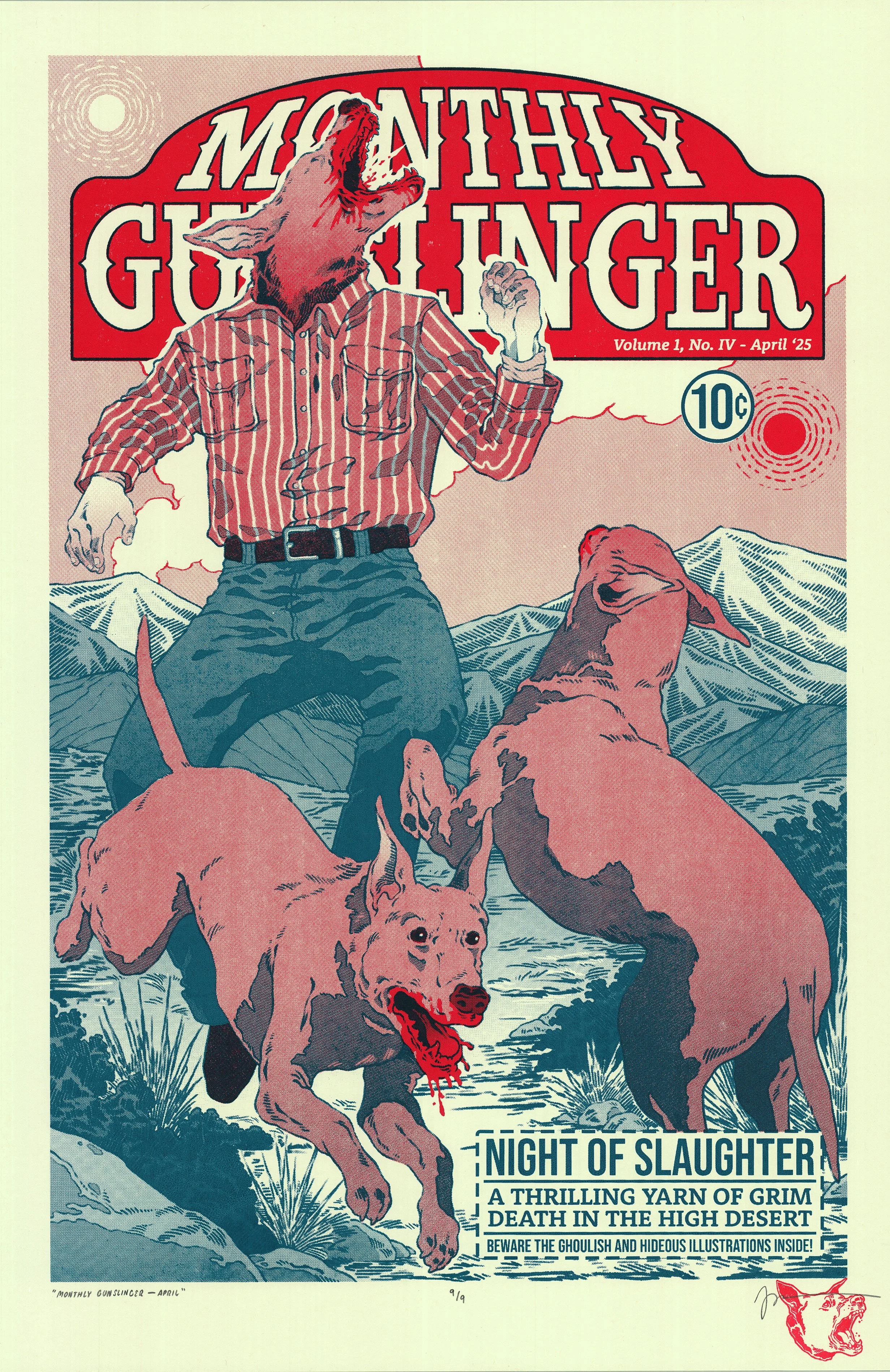
"Monthly Gunslinger - April" - 2025
Of course, the lycanthrope is often primarily associated with transformation. You mentioned several key aspects that you note: the hands as human artefacts, “sumptuousness of the grotesque”, “of your body shifting and breaking to accommodate your bestial”. Could you say a little bit more about these ideas and sentiments?
I’d like to touch on the importance of hands here. In some depictions of werewolves and other lycanthropes, I feel like there’s a potential of their hands mutating and transforming into something much different than human hands. They become more paw-like or they grow claws or pads and become these hideous half-human, half-animal things. For me and my dog-men, it’s really important to maintain the hands as perfectly, totally human.
My reasoning here is two-fold and it revolves entirely around the interplay of violence and vulnerability in my work. Again, my dog-man is both a perpetrator of violence in that he enacts it on other living creatures and on the landscape, but he’s also a victim of violence in that he has been trained and broken into this rapacious, rampaging creature. I think that the presence of his human hands reinforces that. Obviously human hands are often the tools of terrible violence. We’re a very violent species! But, I think they also lend a soft, sad, vulnerable quality to him. I’m not sure if I want viewers to always sympathize with him, but I do want them to see his hands and how much those hands resemble their own.
How did your study and degree in Classics - especially Roman literature and the metamorphic in figures like Ovid and Virgil - prepare and complicate your view of nature - human and otherwise?
My MFA thesis, “Strange Creature,” was almost entirely about how Roman poetry, specifically the interwoven themes of violence and change in Ovid’s Metamorphoses, informs my own understanding of American Western mythology. One of my main points was that those themes of violence and change are nearly inextricable from an “other” place, a place that is beyond immediacy and familiarty, and that’s typically nature. Maybe you could call it the “perpetual frontier,” a place outside of your comfort where something terrible waits for you.
It happens all the time in Metamorphoses. Humans wander into glades or forests, or they cross rivers or some threshold out of civilization and into the wild, and then something just absolutely awful happens to them. They get turned into a tree, or an animal. One of my favorite myths that Ovid retells is the story of Actaeon, an aristocratic hunter, who spies on the goddess Diana while she’s bathing in a locus amoenus, which literally translates to “pleasant place” and connotes a natural place of divine, sublime beauty. She transforms him into a stag and he’s chased down and slaughtered by his own hunting dogs.
I see the same interplay of violence, change, and the natural world in the myth of the American West. Colonizers, people in my family, were drawn out here in endless droves by the promise of positive change. You could change your lot in life, improve your health, become your own man, completely divorce yourself from the you that you were back east, or back even in the old country. Instead, we tore up the landscape, killed the buffalo, massacred Indigenous people. Change happened, but it was for the worst, and it was all set against the backdrop of the frontier, this “unknown” place. I think that’s why I’m so drawn to my dog-man. What a coup, to become instead the victim of such obliterating, atrocious change.