XXXIX. Vile Fluster: looking for creativity in autocorrect and predictive text through Vilém Flusser’s “quanta” by Jamie Jenkinson

Superpowers
When a driverless car crashes, all other driverless cars on that network learn from the event. Unwanted situations that affect one car become shared knowledge, affecting the operation of all the cars on the network. Smartphone users are in a similar network, through entangled uses/agencies/gestures of the collective/individual as user/machine.[1] Individual actions on these networks affect the collective network, and subsequently, the actions of individuals. The necessary use of this system in driverless cars can be argued in pursuit of safety. But when we apply these same systems to the words we write, images we make, and information we see, we should ask: what is being pursued? And how might this effect creativity?
A simple example of these systems can be found in autocorrect and predictive text features, that have become normalised in the use of smartphones, word processors, emails etc. And it is through this familiar tool that we can consider alternative ways of seeing/reading/perceiving, which I address through Vilém Flusser’s concept of “quanta.”
Like much of Flusser’s writings, his views on quanta, and his interpretations of quantum physics, remain relatively unrecognised.[2] The Czech-born Brazilian philosopher wrote in Portuguese, German, French and English, before a fatal car crash in 1991. Over the past two decades, Flusser’s prophetic observations have been resurfacing through new translations. It is in these translations where Flusser’s wider notion of quanta can be recognised, and used to consider the impact of autocorrect and predictive text.
Flusser made a case for quanta in his 1987 book Does Writing Have a Future, in a chapter titled “Digital”, he proposed that ‘we need to devote our full attention to the problems raised by quanta. Far from being solely practical or epistemological issues, these are existential, political, and aesthetic ones. They should not be left to scientists and technicians.’[3]
But quanta — for the most part — has been left to scientists and technicians who build and engineer the computers facilitating the “Information Age” through advances in quantum technologies[4], as the tools we use to distribute information — smartphones, tablets, laptops, smartTVs etc. — currently, and will increasingly function through quantum mechanics.
Our use of digital tools is influencing the way we think/act/doubt/decide in ways like never before. James Bridle has described this phenomenon, stating that as ‘we think more and more like the machine, or we do not think at all’[6]; Lev Manovich highlighting the role of AI’s ‘important role in our cultural lives and behaviours, increasingly automating the processes of aesthetic creation and aesthetic choices'[7]; and Luciana Parisi’s call for ‘a new envisioning of how to think in the age of automated cognition’[8]. These are concerns of what we might call “user culture/s,” where the automation of thinking/creation/cognition has been re/branded as “superpowers.”[9]
One of these superpowers is the ability to spell, which might seem insignificant in the plethora of features marketed to us by big tech. But as someone with dyslexia, autocorrect spelling has felt like a kind of superpower, in its ability to hide my inability to spell correctly. And it is in this relatively simple system of literacy, paired with the complexity and dynamism of language, that the impact of automation and prediction in user culture/s can be considered from the perspective of Flusser’s quanta.
Flusser found parallels between the digital, writing and quantum physics in the late 1980s. The digital highlighted a shift from a world ‘once seen as solid,’ to one best suited to ‘probability and statistics.’[10] This was Flusser’s interpretation of quantum physics, where ‘cause and effect only appear as statistical probabilities.’[11] A conceptualization of reality which although abstract, can be considered in this text, through an awareness of autocorrect. For example, I have spelt one of these words incorrectly, but you do not know which, as it was autocorrected before I finished the sentence. My word processor can do this because the text is seen as, but is not, ‘solid’; it is data. And as data it can be read and interpreted through probability and statistics, with the ability to change the cause and effect of my misspelt word/s into their correct spellings. The result is a series of words that appear to be correctly spelt by me, while actually containing probable corrections of my misspellings.
Had I written this text on paper, my spelling mistakes would be present. Corrections too, would be visible through tip-ex/scribbles/rubbing-out/strikethrough; as solid. Pen to paper cannot correct itself, bound to a form of causality in error and correction. The digital is not bound to such transparency, capable of hiding my inability to spell through desires for a universal correctness. A consequence of this, is that if I want to spell a word incorectly, I have to re/de/spell the autocorrection, making some errors more difficult than accuracy. Could such a universal idea of correctness, including the purposeful error, be a problem raised by quanta?
Vile Fluster
Before the digital, all that appeared intentional/correct could be understood as the product of a conscious mind, and/or serendipitous/supernatural/spiritual forces. In the example of text, a written word on paper is almost certainly the intention of a person. From which, the intention of the word is traceable, with some level of accuracy, to the person that wrote it. This is why the signature is considered such a credible form of intentionality, and as a instantiation of identity, as casual logic ties writer-to-pen-to-mark. The digitally aided user is not bound to such causal logic, as every action is entangled in a dialogue of multiple agencies/probabilities/quanta as the machine processes/corrects/predicts data. This network of intraput (in/output) occurs in and through a process that may benefit from Flusser’s quantum interpretations.
A simplified quantum interpretation is a shift from causal to probable thinking.[12] Such quantum interpretations of the digital may seem purely anecdotal, but as our digital devices have developed through quantum mechanics — some of which extending into their branding and terminology, such as Quantum Dot and quantum efficiency — may we benefit from considering them as systems where ‘cause and effect only appear as statistical probabilities’?[13] This is not to say that the theoretical and physical manifestations of quantum realities are the same. Nor that they are intrinsically connected. But that quantum interpretations — of probability and beyond — are relevant to interpreting digital systems capable of probabilistic logic, particularly those built utilising an awareness of quantum mechanics, expanded accessibly in Brian Clegg’s 2014 book The Quantum Age.
Corrective and predictive systems utilise probabilistic logic through a combination of causal and probabilistic methods, requiring alternative forms of reading. A simplified example can again be found in this text, in re/reading the title “vile fluster.” If this were written on paper, it would read as it was written. But when this statement appeared while reading an early digital draft of my doctoral thesis, I had to apply an alternative reading. I knew I had not written this, that it was an autocorrection of what the machine determined to be incorrect. And so, I had to manually re/de/correct “vile fluster” to “Vilém Flusser.” Some readers may have already applied this probabilistic interpretation to the essay’s title through an awareness of its context. But if this were written on paper, it would be nonsensical to read it as probable as causal and probable writing systems benefit from alternative modes of reading, based on an awareness of a writing’s application.
Machines have the ability to doubt what might otherwise be considered causal. And this ability to be doubted/corrected/predicted/automated has become a key factor/feature of “user-friendly” superpowers. The standardisation of autocorrected spelling in user-devices has led some to describe an ‘autocorrect generation,’ where users have a ‘false impression of their spelling abilities.’[14] This reminds me of a scene in The Matrix, where Neo learns kung fu via download, famously claiming: “I know kung fu.” But could this be reread as auto-kung-fu? And rather than learning the martial art, is Neo being corrected/predicted/automated to carry out the most effective moves? And if my superpower is the ability to spell — one I lose when writing on paper, just as Neo does when he leaves the Matrix’s digital simulation — how might the discrepancy of device-specific abilities affect how we read acts of intention/creativity/superpowers in the matrix of user culture/s?
Auto-Quanta
The prefix “auto-” is Greek for “self,” and began being used to describe machines during the industrial revolution. A notable example is the term “automobile,” which emerged around 1897, and was popularised in the 1950s by Ford motors.[15][16] We might consider this understanding of auto- from a classical/causal/Newtonian/solid perspective, where the use of hydraulic and pneumatic devices could be considered self-moving. It was the quantum revolution that created our current understanding of automation where machines lost their moving parts in favour of solid-state components offering the flow of electrons and photons via computers.
Quantum technologies enabled an idea of auto that dates back to at least Aristotle, who considered automatos: ‘acting of itself’ in 300BC.[17] This ancient concept of automation became a reality in the ability to control the flow of electrons and photons, developing technology through an awareness of quantum mechanics.[18] The Quantum Computer is epitomised as the application of quantum physics in computing, but this is rather a significant and difficult application of a superposition. All contemporary computers apply processes developed through quantum mechanics. And as the application of quantum mechanics improved, so did the technology, enabling smaller, faster and more powerful machines; most notably, the smartphone.[19]
Contemporary technology has changed the notion of auto from movement/motion to “intelligence” and “smart”-ness. Here we begin to verge on deeper forms of probability where ‘acting of itself’ holds some form of agency. Flusser framed digital automation/intelligence/thinking through the ability to doubt and make decisions, which he based on the digital’s use of language.[20] Flusser related all intelligence to systems of language, and foresaw a need to readdress thinking in an age of ‘new digital codes’. But rather than addressing the intellect (which Flusser described as ‘absurd’), he conceived of a way to bypass the ‘complexity of the mind’ through the relative simplicity of ‘thinking machines’, and the notion of quanta.[21][22]
In Flusser’s chapter titled ‘Digital,’ he described how ‘new digital codes arose from the new understanding of thought, and feedback is making us think in quanta and images more clearly the more we use the new codes.’[23] Flusser’s new understanding of thought enmeshes writing/language/code/images with quantum interpretation, which he had raised in his 1983 book Towards a Philosophy of Photography, where he wrote, ‘the structure of the act of photography is a quantum one: a doubt made up of points of hesitation and points of decision-making.’[24] Flusser was framing a manner of addressing the then-new digital tools through a quantum perspective. Making a case for, and raising awareness to, the impacts of quanta due to changes occurring in the processes/acts/gestures of doubt and decision making, as quanta.
Developing these ideas, Flusser described, what we call an idea, a feeling, a wish, or a decision turns out to be a statistical summary of quantum leaps; what we call perception turns out to be a summarising of quantum leaps into a representation.[25]
Put simply, for Flusser ‘thinking “quantizes”.’[26] And it is this process of quantising/thinking, of quanta as doubt and decision-making, that has become automated within our devices. Such “auto-quanta” is sold to users as smart, intelligent superpowers: Apple boast the ‘smartest, most powerful chip in a smartphone’;[27] Google offer ‘on-device AI to give you new superpowers’;[28] and Samsung is ‘AI-powered […] the more it’s used, the more accurate it becomes.’[29] These features are marketed as user-friendly. But as machines automate user quanta, what are users/we gaining from this process, and what is being taken away?
As our personal devices become more automated, we might consider them — in the context of Flusser’s quanta — as becoming more quantum; both theoretically and physically. But although these quantum interpretations are similar in terminology, they are different. The science and theory are connected/similar, but they are not the same; and neither can be considered Truth. A problem here, is that the ‘existential, political, and aesthetic’ problems of quanta in the digital are rarely addressed, while significant developments have and are being made by ‘scientists and technicians.’ So, where science has progressed away from classical thinking, the thinkings/readings/perspectives required to make sense of quantum tools/culture/gestures remain limited; and in cases omitted from consideration.[30]
At the time of Flusser’s writings, quantum interpretations were — as they continue to be — dampened by cases of fringe, often white-neoliberal mysticism.[31] This may have caused Flusser to limit his own use of the terms “quanta” and “quantum,” and for his considerations to go unacknowledged. To the extent that, it’s worth noting, Flusseriana: an intellectual tool box — a dedicated Flusser glossary — does not feature “quanta” or “quantum” in its extensive index of Flusser terms.[32] But over the past decade there have been many significant re/thinkings around quantum interpretations, notably: Rasheedah Phillips and Camae Ayewa’s Black Quantum Futurism; Stephon Alexander’s The Jazz of Physics; and significantly Karen Barad’s “agential realism.”[33][34][35]
These radical approaches to directly interpreting quantum physics offer diffracted considerations to the ‘existential, political, and aesthetic’ problems raised by quanta, as it is not that awareness to quantum solves the problems it raises, nor solves those of classical logic. As Denise Ferreira da Silva has raised,
developments in post-classical physics, relativity and quantum mechanics, have been crucial in the development of theoretical and methodological approaches to the study of economic, juridical, ethical and political issues, which both produce and rehearsed human difference. Unfortunately, they have not yet inspired imaginings of difference without seperability, whether spatio-temporal […], or formal [36].
Quantum mechanics can appear to offer what physicist Werner Heisenberg discussed as “freedom” from classical concepts.[37] But quanta has become equally, if not more controlling/troubling through the application of quantum logic in/to user culture/s. But as da Silva notes, post-classical physics (although not solving issues) has benefited the development of approaches to contemporary issues. And so similar quantum interpretations may also benefit the way we approach user culture/s, especially where quantum mechanics is being used.
The internet, algorithms, computers are all developed through the application of quantum mechanics into technologies.[38] And this is not being hidden, with “quantum” becoming synonymous with new technology.[39] Yet we still appear to struggle with the simultaneous use of classical and quantum logics in our lives, as experienced every time we use our smartphones. While these devices do not directly employ the classically strange elements of quantum mechanics, they are operating in ways that classical physics/interpretations/ideas/philosophies/perspectives cannot account for. And in an age where these devices have dominated contemporary cultures, we might need to consider such alternative perspectives.

Quantum Dialogues
When considering the operation of user devices — let’s say, a smartphone — rather than the sole intentions of a person with a tool, we must consider the agency of multiple players. One way of observing this is through Flusser’s quanta, where we might consider the agency of two players with the ability to doubt and make decisions — i.e. the user and the smartphone — in what I reluctantly call a “quantum dialogue.”
In such a dialogue, it is not to say that all players are the same/universal. Looking initially to Flusser, in his final book Gestures—published posthumously in 1991—we find his distinction from “universal phenomena” in his proposition of “quantised phenomena,” where,
a specific, individual being-in-the-world is expressed in each instance, so that the expression occurs in a space-time specific to the individual, whereby an individual can, for [their] part, be considered a knot in an intersubjective network. [40]
These ideas of Flusser’s have been considered [proto]decolonial[41] in their shifting emphasis away from notions of the universal, what we might consider aspects of classical/Newtonian/solid/enlightenment/colonial thinking/philosophy/theory/science.
Flusser’s considerations can be updated through Barad, who has offered significant contemporary quantum interpretation, much of which operate through neologisms. One of these is the shift of “inter-”(action/relation) by adopting the prefix “intra-”.[42] Barad uses this as ‘a radical reworking of the traditional notion of causality,’ signifying ‘the mutual constitution of entangled agencies [...] only distinct in relation to their mutual entanglement; they don't exist as individual elements’.[43] There are parallels between Flusser’s ‘intersubjective network,’ and Barad’s ‘intra-relations’ (both of which may work towards—but are yet to solve/inspire—da Silva’s differences without separability).[44] And so the term “intra-subjective” might be compatible to discussing quantum dialogues, where the user/device/player is both/neither individual and/or collective.[45]
The intra-subjective quantum dialogue of user devices is complex, but a simplified version can be considered in autocorrection. Autocorrection has been designed to doubt a user’s input, and decide whether or not to act on their behalf by correcting them. In the example of writing a text message, user and smartphone have the ability to doubt and make decisions, from similar yet different, intra-subjective networks. For the most part the system works, but when it does not, the results can be jarring, becoming what has been popularised as “autocorrect fails.”
Autocorrect fails are when a word is autocorrected into a word with an entirely different meaning, making correctly spelt yet syntactically unusual sentences. Early awareness of autocorrect fails were known as the “Cupertino effect”, which dates back to Microsoft Word 97 and its habit of changing “cooperation” to “Cupertino”; a town in California (coincidentally, the hometown of Apple Inc.).[46] The algorithm did this, as only the hyphenated “co-operation” was in its dictionary, causing the system to doubt the correctly spelt unhyphenated version, and make the decision to change it to the algorithm’s most probable, yet unrelated, correction. This led to embarrassing cases, such as a German NATO officer quoted as saying “The Cupertino with our Italian Comrades proved to be very fruitful.”[47]
The majority of autocorrect fails are rarely published outside of personal communications. Those made public are usually serendipitously uncanny, and uploaded to dedicated online forums, social media, and “best of” lists, such as: “The 50 Funniest Auto-Correct Fails” and “The 30 Most Hilarious Autocorrect Struggles Ever”.[48] Autocorrect fails have become part of popular culture, even written into sit-com scripts.[49] A strange phenomena of faking autocorrect fails has become relatively common online, often to produce embarrassing miscorrections, which has made it difficult to find genuine examples.
So, I am using another personal example, this time a text message I received that read “Sumo is lovely.” Although syntactically credible, at no point did I question my friend’s interest in sumo wrestling. I automatically re/de/corrected the text, which was sent to me while I was on holiday on the Greek island, Symi. Re/reading the text in this context, the word “sumo” becomes probabilistic, and can be re/de/corrected as “Symi is lovely.”
We might consider this re/reading as an awareness of a quantum dialogue, which has generated an alternative form of reading based on doubt, which goes beyond writing. Unusual/serendipitous/chance/strange occurrences in user culture have the potential of being probabilistic: Did they mean that? Do they really look like that? Is that ad directed at me? Is that really happening? The probabilistic systems of the digital may encourage doubt, contributing to the phenomena of “fake news”, where the context of fakeness might be attributed to a feedback of doubt as encouraged in user culture/s.[50] But doubt too may benefit from an alternative perspective to the causal logics of classical physics.
If we use causal logic to consider digitally typed sentences such as those mentioned, accuracy is attributed to the user, and error is attributed to the machine. But quantum dialogues are not this simple. Their intra-subjective networks reach far wider than the apparent players. As while a system may appear to operate well, and this operation be attributed to the inventors, this does not mean they are in control of what the system does. This becomes particularly dangerous territory when this logic is being used by big tech to relinquish their errors, and validate their successes, through a lack of causal control in the quantum dialogues they create.[51] To some extent, the technology appears to be guiding its own progress, while opportunists find appropriate uses for it.[52]
Once a purpose is found, the systems appear to retroactively function and appear as necessary, but to what aim? In the example of autocorrection and prediction, are we heading towards a system where our thoughts are automatically predicted and sent, with only the need for minimum user consideration?
Signs of this have been developed in Google’s ‘Smart Compose’ feature of Gmail, which claims its ‘personalized suggestions are tailored to the way you normally write, to maintain your writing style.’[53] The programme is able to predict names, introductions, subject headings and sentences for the user. It does this through machine learning, where ‘language understanding models use billions of common phrases and sentences to automatically learn about the world,’ which they raise ‘reflect human cognitive biases’, which users should be ‘aware of.’[54] This is one problem of an intra-subjective network, where collective biases of a system can be applied at an individual and/or collective level.[55] For example, studies have shown predictive text messaging to show gender biases, and emphasis positive phrases.[56][57] But in the development of autocorrect and predictive text, another troubling element is how/when these systems can be correct. The question then, is whether this is a problem, too?
If we accelerate the development of predictive systems, what happens when systems like Gmail—due to their knowledge of all your communications/locations/habits/friends/etc.—are able to write, with a small margin of error, the email you intended/needed to write, including your ‘normal’ structures, and ‘maintaining’ friendly formalities? And what happens when the recipient knows this, and they lose their relevance? Requiring recipient software to highlight important information? Turning an automated email with simulated familiarities, into a streamlined notification asking “Meet Akwasí Tuesday 10:30: yes/no?” Or simply notify you that the meeting has been booked, as it knows/writes your calendar as well.
In this speculation, the nuances of writing and communication are removed in favour of efficiency, which could be argued as the aim of autocorrection, prediction, automation and quantum dialogues more generally under capitalism. As rather than aiding the user to overcome/utilise/feel/ embrace their in/abilities, our devices are streamlining the efficiency of correct content production. Elements of which Mckenzie Wark has commented on, stating that “in practice, this emergent ruling class of our time insists on the confinement of particular acts of creation within the property form and access to collective creative activity, from which to harvest information in the aggregate.”[58] In the automated streamlining of information harvesting, users are encouraged to check/doubt their predictions, while losing the agency/choice/option/ability to make their own decisions—and perhaps, the ability to be creative.
OMG
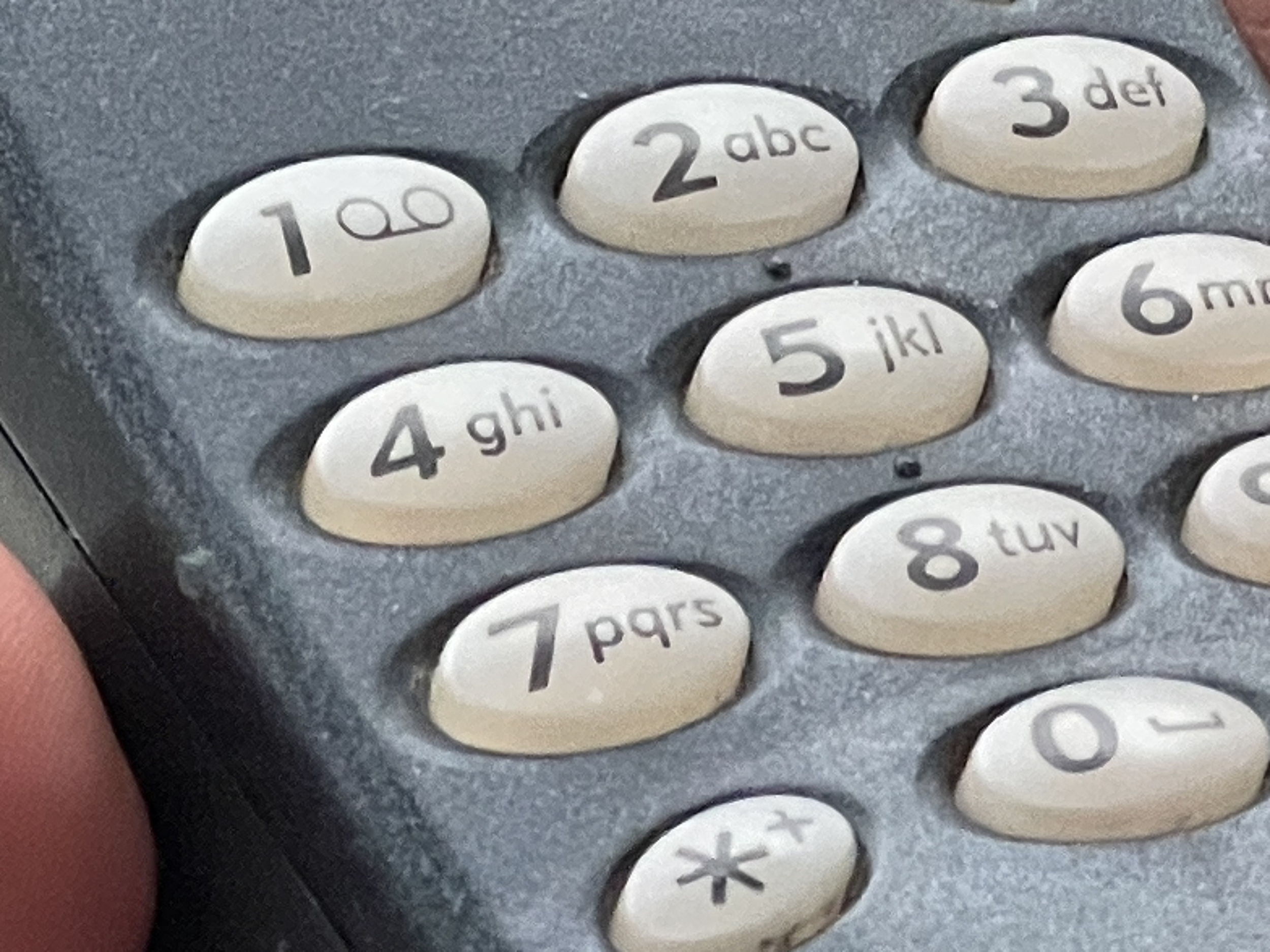
The mobile phone necessitated what might be considered the most democratically creative period in the history of writing. This can be attributed to two factors: the E.161 multi-tap telephone keypad; and Short Message Service (SMS).[59][60] E.161 uses a numerical input of 0–9, with letters in small groups across keys 2-9. Specific characters are selected by repeatedly pressing the affiliated number. The time-consuming process of multi-tap typing, combined with SMS’s limitation of up to 160 characters, encouraged creative abbreviations, acronyms and initialisms that have become iconic of user culture, such as “LOL,” “OMG” and “r u gd?”[61]
Another outcome of the multi-tap keypad is the lesser documented “mis-tapping.” Where slight miscalculations of the multi-tap input resulted in strange nonsensical word-forms unique to E.161. And due to the mobility of the phone, users could text while drunk, which often lead to such mis-tappings. For example “mn mx waw homd” is only 4 mis- tapped keys from “on my way home.” To make sense of this, as mis-tapping held no phonetic reference, the E.161 keypad became a sort of causal codebreaking tool for the receiver—and sometimes the sender—to figure out what had been mis-tapped.
These pre-autocorrection adaptations can be considered nonconformist, even radical in the context/history of writing. Producing creative and unique approaches in the production and reception of words unique to E.161, and a democratisation of the creative process of neologisms. But this influential period was short lived, as a user-friendly upgrade known as T-9—short for ‘Text on 9 keys’—streamlined the multi-tap system, and its creative process.[62] T-9 continued the E.161 layout, but developed an algorithm to remove the multi-tap feature, requiring a single-tap on each key, and running a system of probability. Once a series of keys had been selected, T-9 would generate all possible configurations of the number series and related characters, selecting the most probable word from possible “textonyms.” For example, typing “2665” would give the options of “book”, “cool”, “bonk”, “conk” etc. The system was effective, and rendered the nonsensical word structures of E.161 a near impossibility, as only recognised words could be probabilised. But the system—at least at first—did not recognise the creative responses to E.161.
Although T-9 formed correct words, this did not prevent undesired syntax. The words selected by T-9 were not always the user’s intention, necessitating readers to develop a probable approach to reading. Where E.161 mis-tappings required a causal deciphering of individual characters into words, based on the keypad, T-9 operated on the level of words into sentences, requiring a probabilistic deciphering of system and user. This led many users to associate the word “book” as probably meaning “cool”.[63] Where “book” is a more probable literary word, and “cool” a more probable cultural word. These systems required alternative forms of reading beyond phonetics that saw text as probable in relation to their respective systems. A dramatic lack of awareness to such probabilistic text took place in Bolton, Lancashire, where “mutter” was autocorrected, or mis-tapped, to “nutter.” The use of nutter escalated the situation into a violent argument in which the recipient was killed.[64] A probabilistic interpretation of the text may have defused this altercation. But when read as the sole intention of the user, outside of quantum dialogue, it is difficult to see otherwise. T-9 and E.161 faded out of use as smartphone’s adopted the qwerty keyboard, which became relatively standardised in the early 2010s, giving smartphone users the same process of input as a desktop or laptop computer. This meant that the same autocorrect features from word processor software could be applied to smartphone users, in the assumption that users required/desired the same level of professionalism in their writing.
Autocorrect imposed/enabled a much more complex quantum dialogue than T-9’s limited range of possibilities. It could be argued that the inclusion of autocorrection has decreased the development of text-based colloquialisms, and increased the conformity of writing, when compared to E.161. But could this be an issue of perspective? What Flusser raised through similar considerations of the digital, as requiring a ‘completely different critical method’ claiming that ‘alphabetic thinking is useless […] We will have to learn to write digitally.’[65] But in understanding how to write, shouldn’t we first learn how to read?
Alternative Perspectives
Pre/around/despite the developments of a Newtonian driven Enlightenment, cultures form/ed alternative, mystical readings to account for happenings/events/moments in their/your/our lives and the world/s around them/you/us. Scientific developments discredited such mystical ideas, in what was naively considered empirical proof of a causal/deterministic/nihilistic universe (and the imperialist power it offered). And although quantum physics has superseded causal logic as a universalism—turning Newtonian beliefs into their own mystical pseudo-sciences—the dominance of classical physics means that the quantum can still feel weird and spooky. But even Newton, rather than the first scientist, has been re/considered as “The Last Magician” due to his hidden interests in the mystical art of alchemy.[66]
For some, quantum interpretation is seen as an excuse to form new mystical beliefs around the nature of the universe.[67] For others, it has become a source of inspiration to re/view the world/s we live in. Flusser’s ideas of quanta are not intended as a universalist phenomena, to be applied to all things at all times. But rather to suggest that this perspective may be relevant to user culture/s. Quanta may be considered an alternative perspective, offering alternative insights into how user culture/s function in practice, theory and technology. As rather than asking: is/are quanta the Truth? Can we consider: how might quanta alter our understanding of creativity? As if there is no true/correct/accurate form of perspective—if all perspectives are, in their own way, mystical—then we can use/try alternatives?
When applying quanta to user culture/s, we find the dialogue of user and machine, one that can be considered an intra-subjective quantum dialogue. Autocorrect is a very simple example of such a dialogue. As for a machine to know whether or not a word is misspelt, or that a sentence forms unusual syntax, is based on a relatively narrow set of concrete rules/values/habits/rituals. If we think of this in terms of probable words written in English, there is a maximum of around 171,476 variables.[68] Possible variables are increased in the prediction of phases and sentences, with billions used for Google’s smart compose.[69] But this is still a fraction of the computational processing—the doubt and decision making, the quanta—of our more advanced and abstract systems; those without clearly defined or predetermined rules/values/habits/rituals.
The smartphone camera is a pinnacle example, employing some of the most advanced forms of automation in any device. With a probable variable consisting of billions of colours, to be selected for millions of pixels per image. Apple’s A13 Bionic Chip, used in their iPhone 11 series, runs its ‘Apple-designed image processor’ with the potential of ‘over five trillion operations per second.’[70] Each “operation” can be considered an act of quanta. Which, through the intra-subjective quantum dialogue of user and device, form intra-subjective decisions.
The creativity of machine-aided decisions can be tarnished by the aid of the machine, in what might be considered a causal perspective. As aesthetic decisions become autonomous (such as autofocus, autoexposure, auto-white balance, stabilisation, colourisation, etc.), it can be difficult to establish individual/causal moments of creativity to attribute to a single user/artist/visionary/genius. Apple exemplify such a logic in their ‘Shot on iPhone’ advertising campaign, featuring images made by iPhone users, credited ambiguously on a could-be-you first name basis, i.e. ‘by Fred.’ These ideas hark back to early difficulties around ascribing creativity to the sophistication/automation of the analogue camera apparatus.[71] And if automation further removes the creative process—as it may have in E.161—could the sole purpose of our smartphone aided superpowers be the more efficient production of information/content/advertisements/datasets to be harvested?
Flusser foresaw elements of today’s user culture/s in 1985, of what he called “envisioning”: ‘in the future, everyone will envision. Everyone will be able to use keys that will permit them, together with everyone else, to synthesize images on the computer screen.’[72] And with over 80% of the global population using smartphones, this is becoming a reality.[73]
The world in which they find themselves can no longer be counted and explained: it has disintegrated into particles—photons, quanta, electromagnetic particles. It has become intangible, inconceivable, incomprehensible, a mass that can(not) be calculated. Even their own consciousness, their thoughts, desires, and values, have disintegrated into particles, into bits of information, a mass that can(not) be calculated. This mass must be computed to make the world tangible, conceivable, comprehensible again, and to make consciousness aware of itself once more. That is to say, the whirring particles around us and in us must be gathered onto surfaces; they must be envisioned.[74]
These somewhat totalising views may not be applicable to everyone, or everything. I am unsure of their relevance when making a cup of tea. But when it comes to using, or simply owning a smartphone, Flusser’s ideas of envisioning quanta hold relevance. And as our devices continue to correct/automate/predict our actions/agency/gestures in user culture/s and the world/s around us; finding alternative forms of creative expression within these systems—those that go beyond error/fail/glitch as intentionally or accidentally[75]—may be essential to comprehending/challenging/criticising the systems. To find/see/make alternative forms of creativity in user-friendly superpowers beyond data harvesting. To shift our perspectives to alternative forms of criticism and creativity in the tools of user-culture/s.
Flusser considered a shift in perspective in his 1985 book Into the Universe of Technical Images. Here he described how ‘The old criticism, this dismantling of solid things, would be lost in the gaps between intervals, in nothingness […] For it is clear from the outset that there is nothing solid to be criticised in the new.’[76] We might consider what is old/new for Flusser, as classical/quantum (as not linearly/historically distinguished, but as two alternatives within a multitude of perspectives/mythologies). In this sense, it is not a case of finding the True perspective, but of applying/diffracting perspectives suitable to the subject/tool/experience at hand, i.e. pen-on-paper, E.161, T-9, autocorrect, prediction, photograph, video, drawing, scanning etc. And perhaps, by raising these alternative perspectives through alternative creative approaches, the problems raised by quanta in user culture/s might be addressed beyond scientists and technicians.
Here—and throughout the text—I use Karen Barad’s notion of ‘cutting together apart’ in the use of the forward slash, which produce: ‘Entanglements are not unities. They do not erase differences; on the contrary, entanglings entail differentiatings, differentiatings entail entanglings. One move – cutting togetherapart.’ See “Diffracting Diffraction: Cutting Together Apart” (Barad, 2014)
see Mark Poster’s introduction to Does Writing Have a Future? (Flusser, 2011a).
see page 142 of Does Writing Have a Future? (Flusser, 2011a).
see Brian Clegg’s The Quantum Age (Clegg, 2014)
see page 88 James Bridle’s New Dark Age (Bridle, 2018)
see location 44 of Lev Manovich’s AI Aesthetics (Manovich, 2918)
see Luciana Parisi’s essay “Reprogramming Decisionism” on e-flux (Parisi, 2017)
“Pixel 3’,” Google, accessed March 17, 2019: https://blog.google/products/pixel/pixel-3- and-device-ai-putting-superpowers-your-pocket/
see page 141 of Does writing have a future? (Flusser, 2011a).
ibid
see page 16 of Carlo Rovelli’s Seven Brief Lessons on Physics (Rovelli,
see page 141 of Does writing have a future? (Flusser, 2011a).
“Poor spelling of 'auto-correct generation' revealed” BBC, accessed July 21, 2019: https://www.bbc.co.uk/news/education-18158665
The Royal Automobile Club was established in 1897 for rich people who could afford this new technology.
see page 23 of Springer Handbook of Automation. (Shimon Y. Nof, 2009)
ibid, 22
see page 77 of Brian Clegg’s The Quantum Age (Clegg, 2014)
ibid, 3
see page 145 of Does writing have a future? (Flusser, 2011a)
see page 62 of On Doubt (Flusser, 2014a)
see pages 143-144 of Does writing have a future? (Flusser, 2011a)
see page 145 of Does writing have a future? (Flusser, 2011a)
see page 39 of Towards a Philosophy of Photography. (Flusser, 2000)
see page 143 of Does writing have a future? (Flusser, 2011a)
ibid, 144
see “iPhone XS,” Apple, accessed March 17, 2019: https://www.apple.com/uk/iphone- xs/
see “Pixel 3’,” Google., accessed March 17, 2019: https://blog.google/products/pixel/ pixel-3-and-device-ai-putting-superpowers-your-pocket/
see “Samsung S10,” Samsung, accessed March 17, 2019: https:// news.samsung.com/global/interview-smart-and-shareable-developing-the-galaxy-s10s-do- it-all-battery
see Imogen Clarke’s “How to manage a revolution: Isaac Newton in the early twentieth century” (Clarke, 2014)
exampled in Kathy Freston’s Quantum Wellness: A Practical Guide to Health and Happiness (Freston, 2009).
Siegfried Zielinski, Peter Weibel, and Daniel Irrgang, eds. Flusseriana: An Intellectual Toolbox. (Minneapolis, MN: Univocal Publishing, 2015)
see Black Quantum Futurism: Theory and Practice. Volumes one & two (Phillips, 2015, 2021)
The Jazz of Physics, 2016 (Alexander, 2016)
see Meeting the Universe Halfway: Quantum Physics and the Entanglement of Matter and Meaning, 2007 (Barad, 2007)
see page 5 of “On Difference Without Separability” (da Silva, 2014)
see page 4 of Werner Heisenberg, Carl Eckart, and Frank C. Hoyt. The Physical Principles of the Quantum Theory. (Mineola, NY: Dover Publ., 2009)
on page 263 of Brian Clegg’s The Quantum Age ‘It’s almost pointless to try to imagine a world without quantum technology’ (Clegg, 2014)
we find this in QLED TVS “Quantum Light Emitting Devices,” Quantum Dot sensors, and even in sporting equipment such as the Asics Gel - Quantum 180 trainers, and Dakine Quantum wetsuit.
see page 173 of Gestures (Flusser, 2014b)
on page 145 of Vilém Flusser. An Introduction he is described as having ‘a postcolonial perspective, long before this school of thought established itself’ (Finger, Guldin & Bernardo, 2011)
see page 33 of Meeting the Universe Half Way (Barad, 2014)
ibid
see “Hacking the Subject: Black Feminism and Refusal beyond the Limits of Critique” by Denise Ferreira da Silva (da Silva, 2014)
Barad discusses Bohr’s use of the term intersubjective, so intra-subjective may not be considered Baradian, but possibly Flusser/Barad.
"The Fasinatng... Fascinating History of Autocorrect”, Gideon Lewis-Kraus, accessed March 21, 2020: https://www.wired.com/2014/07/history-of-autocorrect/
Ben Zimmer. "When Spellcheckers Attack: Perils of the Cupertino Effect,” Oxford University Press, accessed August 2, 2019: https://blog.oup.com/2007/11/spellchecker/
Jessica Misener ed. “The 30 Most Hilarious Autocorrect Struggles Ever,” BuzzFeed, accessed August 6, 2019: https://www.buzzfeednews.com/article/jessicamisener/the-30- most-hilarious-autocorrect-struggles-ever
see Season 5, Episode 20 of Brooklyn Nine-Nine.
see page 145 of Does writing have a future? (Flusser, 2011a)
The ongoing miscommunication between big data and their accountability continue in the cases of Cambridge Analytica and Facebook
see Coded Bias narrated by Joy Buolamwini.
see “Use Smart Compose”, Google Support, accessed July 21, 2019: https:// support.google.com/mail/answer/9116836?co=GENIE.Platform%3DDesktop&hl=en
ibid
see Timnit Gebru and Joy Buolamwini’s article “Gender Shades,” (Gebru and Buolamwini, 2018)
see “Predictive Sexism” (https://www.uswitch.com/mobiles/predictive-sexism/)
see “Sentiment Bias in Predictive Text Recommendations Results in Biased Writing” (https://www.eecs.harvard.edu/~kgajos/papers/2018/arnold18sentiment.pdf)
see page 3 of Capital is Dead: is this something worse (Wark, 2019)
see page 1 of International Telecommunication Union, Series E: Overall Network Operation, Telephone Service, Service Operation And Human Factors (Geneva, CH: ITU Publishing 2001)
see page 10 of International Telecommunications Union, Series X: Data Networks, Open System, Communications And Security (Geneva, CH: ITU Publishing, 2009)
as utilised n the writings of The White Pube
“How T9 Predictive Text Input Changed Mobile Phones”, Priya Ganapati, accessed March 21, 2020: https://www.wired.com/2010/09/martin-king-t9-dies/
see “Definition of Book” on Online Slang Dictionary, accessed March 21, 2020: http:// onlineslangdictionary.com/meaning-definition-of/book
“Jail for Salford knifeman who stabbed friend to death in row over text message,” Manchester Evening News, accessed August 6, 2019: https:// www.manchestereveningnews.co.uk/news/local-news/jail-for-salford-knifeman-who- stabbed-857691
see page 152 of Does Writing Have a Future (Flusser, 2011a)
see Renny Bartlett’s Isaac Newton: The Last Magician (Bartlett, 2013)
Physicist Murray Gell-Mann coined the phrase "quantum flapdoodle" to refer to the misuse and misapplication of quantum physics to other topics.
based on the amount of usable words in the Oxford Dictionary.
see “Use Smart Compose”, Google Support, accessed July 21, 2019: https:// support.google.com/mail/answer/9116836?co=GENIE.Platform%3DDesktop&hl=en
see article “An Exclusive Look Inside Apple’s A13 Bionic Chip,” accessed September 21, 2019: https://www.wired.com/story/apple-a13-bionic-chip-iphone/
see Walter Benjamin “Art in the Age of its Technological Reproducibility”
see page 31 of Into the Universe of Technical Images (Flusser, 2014)
see “Number of smartphone subscriptions worldwide from 2016 to 2027”, accessed March 30, 2022: https://www.statista.com/statistics/330695/number-of-smartphone-users- worldwide/
see page 31 of Into the Universe of Technical Images (Flusser, 2014)
see Luciana Parisi and Stamatia Portanova “Soft thought (in architecture and choreography)”: ‘Looking for the glitch in the functionality of the algorithmic system, or waiting for new qualities and affects to be generated by it, have so far been the two interwoven, polarizing tendencies of contemporary digital aesthetics’ (Parisi and Portanova, 2011).
See page 152 of Does Writing Have a Future (Flusser, 2011a)